The third interface for AI was built by someone else
When Anthropic launched Claude Tag, the feature that lets you @mention Claude inside Slack and hand it real work, Andrej Karpathy reposted the announcement with a framing worth chewing on:
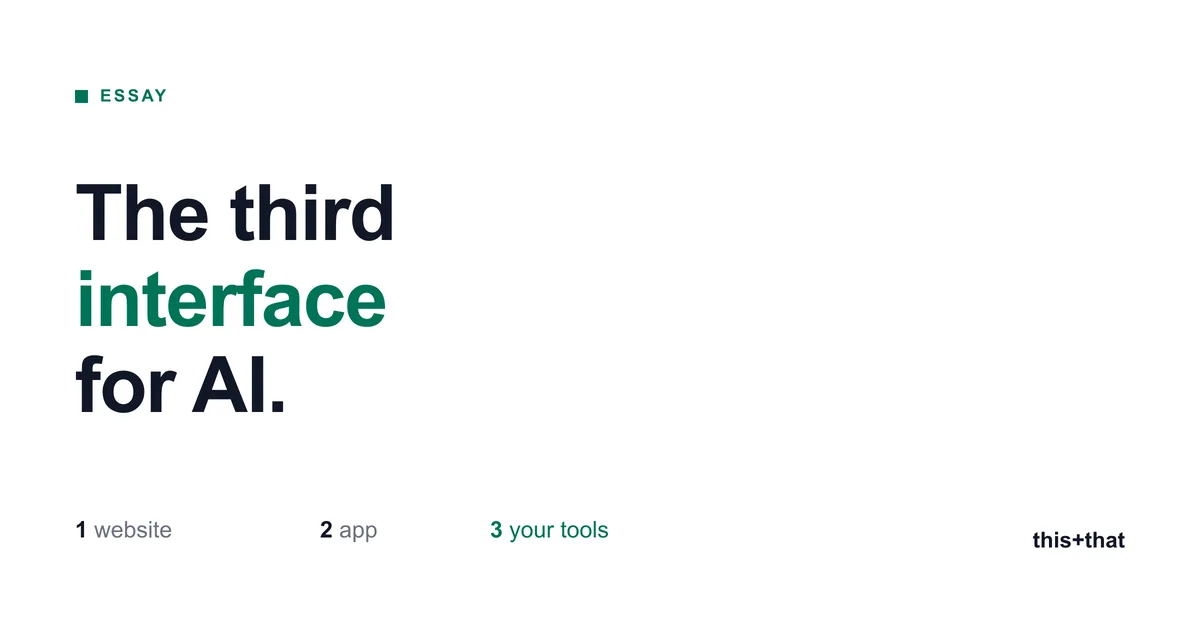
Imo this is the 3rd major redesign of LLM UIUX. The first paradigm was that the LLM is a website you go to, the second was that it is an app you download to your computer. This third one is that it is a self-contained, persistent, asynchronous entity with org-wide tools and context, working alongside teams of humans.
The tell in the arc
He’s right that it’s a genuine shift. But there’s a detail in the arc he draws, and it’s the most important part. In the first two generations, the interface belonged to the model company. The website was OpenAI’s. The desktop app was Anthropic’s. You went to them. In the third generation, the interface belongs to someone else entirely. Claude Tag lives in Slack. Anthropic built the integration, but it didn’t build the surface, and it doesn’t own the room. The most advanced way to use the best model in the world is now to summon it into a product another company made.
That isn’t a small thing. It’s the moment the model stops being the destination and starts being the ingredient.
”Commoditized” is the wrong word
The usual way people say this is “LLMs will be commoditized,” which sounds like a prediction, and a slightly mean one. But Anthropic going into Slack isn’t commoditization. That would be Slack swapping models based on cost, or letting the customer pick which one runs. What it shows instead is something else, and something less mean: the value has moved up the stack.
Models aren’t getting worse. We’ve just gotten used to how good they are, and started to notice that a great model on its own isn’t the whole story. A model wired into the right context and tools beats a great model alone by a wide margin. One and one adds up to more than two.
Claude in Slack makes the point. The model answering you there is no better at the back-and-forth than the Claude or ChatGPT or Gemini you’d open in a chat window. What it has that they don’t is everything already around it: the threads, the files, the decisions, the running context of how your team works. In a chat window you import all of that by hand, pasting it in piece by piece. In Slack you don’t, because that’s where it already lives. So why haul your work over to the model when you can bring the model to your work?
The model becomes a powerful, shared utility, and the value moves to whatever holds your context and sits on top of it.
Anthropic clearly understands this, which is why Claude Tag exists at all. Going where the users already are, inside the tools they live in, is the right move. It’s also a quiet admission: the surface matters more than the model, even to the company that makes the model.
You won’t know which model you’re using
This is the bet we’ve made at this+that from the start. Work arrives across your email and chat, and an AI reads it, pulls out the tasks, and runs the workflows to handle them, grounded in a knowledge layer about how your team actually works. There’s a model doing the reasoning, but it’s an implementation detail. You relate to this+that, not to the LLM underneath it. Most people who use it will never know or care which model is running.
Today that model is our pick. Where we want to take it next is to hand you the choice: let you delegate to a model of your own, including one running locally on your own machine. We took the first step recently. You can already route work to Claude Code on your own device, running on your own subscription rather than ours. A model running fully locally is further out, but it’s where the philosophy leads. The model should surface exactly once, when you decide it matters, and never otherwise.
That’s what “the model is the ingredient” feels like in practice. The same way you don’t think about the database behind your CRM, you don’t think about the model behind your AI. You choose the product wrapped around it, the one that holds your context and does the work.
The layers are converging
There’s a strategic reading here that cuts against the doom version of commoditization. If the most valuable way to use a model is inside the apps people already work in, then the model companies need those apps as much as the apps need the models. The two layers are converging. The labs that win won’t be the ones with a marginally better model. They’ll be the ones that reach people where the work actually happens. Don’t be surprised if the model builders start building rich, opinionated interfaces of their own, rather than only plugging into other people’s. Anthropic moving into Slack is a first step in that direction, not the last.
The same idea from a new angle
We’ve made versions of this argument before. The second wave of software is fit-for-purpose AI apps, not general chat. And when we ran 7 Powers on ourselves, the conclusion was that technology itself is no longer a moat, because anyone can build on the same models. Karpathy’s third interface is the same idea arriving from a different angle. When the model is the ingredient, the durable things are the surface people choose, the knowledge it accumulates, and the work it gets done.
Key takeaways
- Karpathy frames three eras of LLM UX: a website you visit, an app you download, and an agent that lives in your tools.
- The tell in the third era is that the interface belongs to a third party (Slack), not the model company. The model is becoming the ingredient.
- “Commoditized” is the wrong word. Models aren’t interchangeable on price; the shift is that a model plus your context beats a model alone, so the value moves up the stack to whatever holds that context.
- this+that is built for that world: the model is invisible and you relate to the product. Letting you choose the model yourself, including a local one, is the direction we’re headed, not something we ship today.
- The strategic read: the model layer and the app layer are converging, and the labs that win will be the ones that reach people where they already work.