The Third Wave of Productivity Applications
Productivity and coffee often go hand in hand, but this is even nerdier than third wave coffee.
Productivity applications evolve in waves. The first began with VisiCalc and WordPerfect and peaked with Microsoft Office, which consolidated writing, spreadsheets, presentations, calendar, and communication into a single suite. Google ushered in the second wave with Docs, Sheets, Slides, Calendar, and Gmail. They brought cloud access and live collaboration at the cost of feature depth.
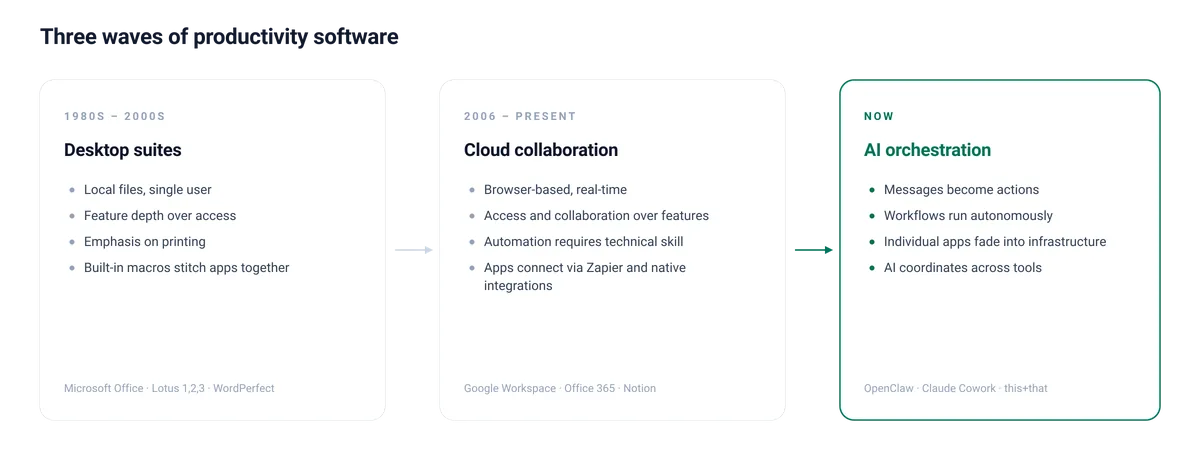
Agentic AI tools may herald the third wave. AI could be a genuine collaborator, not just a set of features bolted onto existing apps. If so, the shifts will be significant. And they’ll start with communications.
This isn’t speculation. It’s already happening. OpenClaw proved that messaging-connected AI agents could take action on your behalf, not just respond. It went viral because it showed people what it feels like when your messages become a control surface for getting things done. Now the major players are racing to build their own versions. In March 2026 alone, Microsoft launched Copilot Cowork, which grounds AI across Outlook, Teams, and all of M365. Anthropic shipped Dispatch, letting Claude control your desktop remotely. OpenAI added email connectors to ChatGPT. Every major AI company is converging on the same insight: the next step isn’t smarter apps, it’s AI that acts on your behalf, starting from your messages.
Communications tools are key
McLuhan said the medium is the message, but that assumed humans process messages. When AI extracts tasks and acts on them, the medium stops mattering. A formal email, a Slack ping, and a rambling thread all produce the same outcome: the work gets done. The medium fades. The action remains.
This is why communications leads. It’s where AI first reliably collapses intent into execution.
Email previews the arc: from “organize everything” to “search everything” to “focus on what matters” to “approve suggested replies.” The next steps follow the same trajectory. And they’re overdue. Knowledge workers spend a substantial portion of their time on email and chat. Something has to scale beyond human attention.
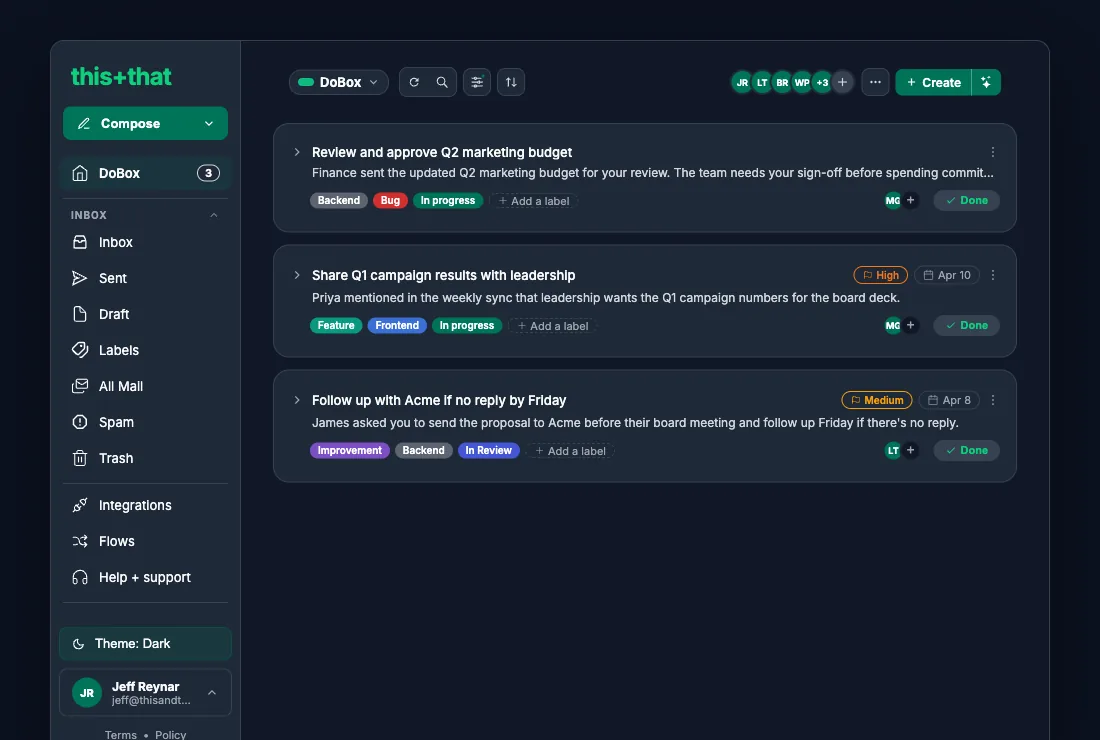 The DoBox: a unified task view with auto-extracted action items from email and Slack. Every task links back to the message it came from.
Every major AI company is now racing to embed agents inside communications. The question isn’t whether this shift happens. It’s who builds and scales the full loop: from messages, to tasks, to workflows, to autonomous action.
How productivity tools evolve
Once communications becomes the AI coordination layer, the rest of the productivity stack reorganizes around it. Some of these shifts are already underway. Others will take years. But the direction is clear.
The suite disappears
If AI orchestrates work across tools (e.g. creating a spreadsheet from sales data while crafting the narrative), individual apps recede into the background. When AI is the primary interface and documents are consumed as read-only summaries, the underlying editors become invisible infrastructure. They’ll get commoditized and may be replaced by OS-bundled tools, open source software, or lightweight apps that ship with AI agents. The revenue model shifts from paying for apps to paying for AI that orchestrates them. Communications and calendar are the exceptions. They will remain visible and sticky and users will continue to make active choices about which products to use.
Documents unbundle and simplify
Just as messages collapse to tasks, documents collapse to ideas with supporting data. Presentation becomes AI’s job at consumption time, not the author’s at creation time. This accelerates the long trend toward simpler formats (from Office to Google Docs to Markdown), because agents work better with simple, well-documented file types and rich formatting matters less when AI handles presentation for the reader. The document becomes a starting point for conversational exploration, not the final word.
The integration layer inverts
Instead of apps integrating with each other via Zapier or native connectors, they integrate with AI. Anthropic’s Model Context Protocol (MCP) is an early example: a standard that lets AI connect to any service. OpenAI’s ChatGPT connectors for Gmail and Outlook are another. The AI becomes the universal connector. You describe what you want moved between systems rather than configuring workflows. This shift is no longer theoretical; it’s happening today.
Knowledge libraries amplify everything
AI becomes more powerful with access to domain knowledge: personal documents, company repositories, and third-party expertise like legal databases and medical references. A consultant’s AI might draw from personal files and firm frameworks alongside published industry research. With these sources combined, AI moves from helpful to authoritative.
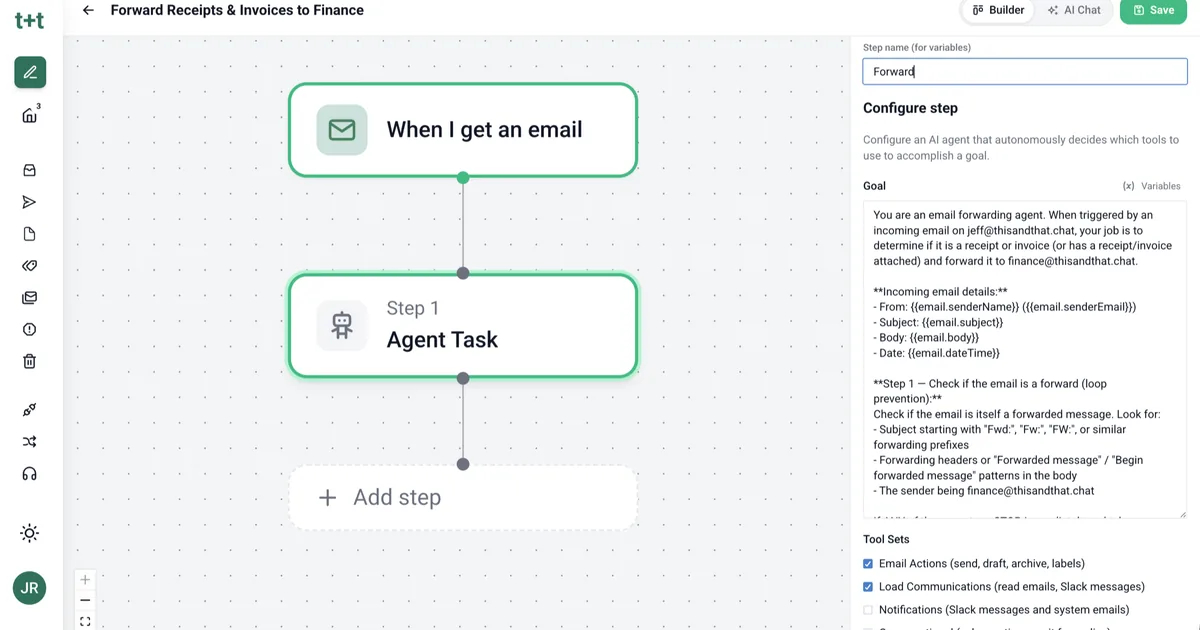 A workflow in this+that that triages incoming email, labeling, forwarding to finance, and drafting replies automatically. This is one example; workflows can span any combination of actions across email, Slack, calendar, and connected tools.
Task extraction is the first step. Workflows are the second. Once AI identifies what needs doing, it can also do it: draft the reply, update the CRM, notify the team, schedule the follow-up. The distance between “this email needs action” and “the action is done” collapses to a workflow that runs itself. That’s the real shift: not smarter tools, but work that finishes without you.
The destination
These shifts will unfold over years as tools mature and habits change, though exponential productivity gains should accelerate adoption compared to earlier waves.
Until recently, most AI investment added intelligence within individual applications. Copilot made Outlook smarter. Gemini made Gmail better. But the recent moves signal something different. Anthropic didn’t ship Dispatch to summarize your email. Microsoft didn’t launch Copilot Cowork to make Outlook slightly faster. These companies are building AI that works across tools, from intent to execution. And they’re all moving at once, which is itself a signal.
Communications is the natural starting point because that’s where intent lives, buried in messages. From there, the rest follows. Productivity tools understand your context, act on your behalf, and learn from your feedback. Calendars negotiate and optimize. Documents assemble on demand. And the workflows that connect these tools run autonomously, triggered by your messages, shaped by your rules, executed without your involvement.
Cloud-centric suites face a strategic tension: their revenue depends on users valuing discrete applications, precisely what fades when AI orchestrates work across them. The companies best positioned for the third wave will be those that embrace this shift rather than defend against it.