Your customer's clock starts when they hit send
A prospect emails you at 6pm on a Friday. Someone opens it at 9am on Monday and replies by 9:15. To whoever answered, it was a 15-minute job. To the prospect it was 63 hours, plenty of time to ask someone else.
Two clocks
Every message has two clocks. The customer’s starts when they hit send. The team’s starts when somebody notices the message.
A team that measures from that moment looks quick, because it leaves out the part the customer feels most: the evening, the weekend, the lunch hour, the morning spent in meetings.
How big the gap is
Harvard Business Review audited 2,241 US companies and found the average reply to a website lead took 42 hours. 23% never replied at all, and only 37% answered within an hour. On the other side, HubSpot found that 82% of customers call an immediate reply important on a marketing or sales question, and HubSpot counts immediate as 10 minutes or less.
Support requests are a different kind of message with the same gap. 90% of customers call an immediate reply important on a support question, in the same HubSpot research, and SuperOffice’s benchmark of 1,000 companies put the average reply at 12 hours and 10 minutes.
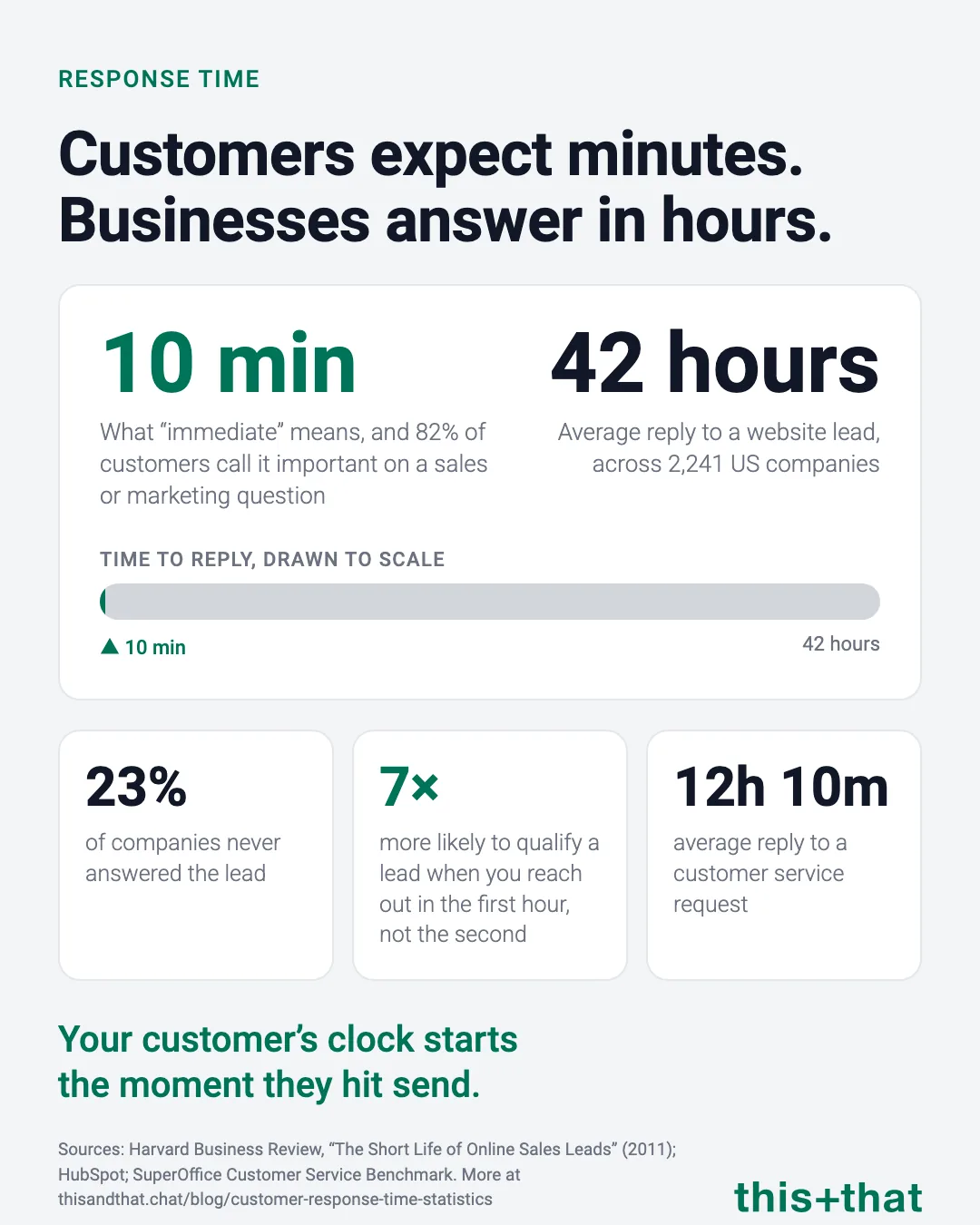
The gap matters because speed decides outcomes. The same HBR research, across 1.25 million leads, found companies that tried to contact a lead within an hour were nearly seven times as likely to qualify it as those that tried an hour later. The audit dates from 2011 and one of its authors ran a lead-response software company, so read the multipliers as direction rather than precision. We keep the sourced numbers, with their caveats, in our customer response time statistics.
Why people lose this race
Customers compare your reply with the fastest ones they’ve had, and they write around the clock. A week has 168 hours. A team that works nine to five on weekdays covers 40 of them. A message that arrives in the other 128 hours waits until someone is back.
Small teams feel this most. Customers hold a company with five employees to the same ten minutes as an enterprise with a support desk in multiple time zones. Adding people makes the team notice sooner. The customer’s clock keeps running whenever nobody is there.
Move where the clock starts
You close the gap by changing what happens in the hours nobody is watching. AI reads each message when it arrives, works out what was asked, and prepares the answer from what the team already knows: the price list, the delivery schedule, the policy on refunds. We recommend starting with a person approving every reply that goes to a customer. Approving a finished draft is quick enough to do on the way out the door, or from a phone at a kid’s soccer game on Saturday morning, so the Friday-evening lead has its answer that weekend instead of on Monday. Once a team trusts the answers to a routine request, the workflow can send those replies itself.
That’s the loop workflows run in this+that. A workflow reads messages across Gmail, Outlook, Slack, Microsoft Teams, and Google Chat the moment they arrive, turns them into tasks in DoBox, and hands them to a person with the answer ready.
You can measure your own gap this afternoon. Take the last ten inbound leads or support requests, and for each one compare the time it arrived with the time your first reply went out. Count nights and weekends.