AI should earn the right to hit send
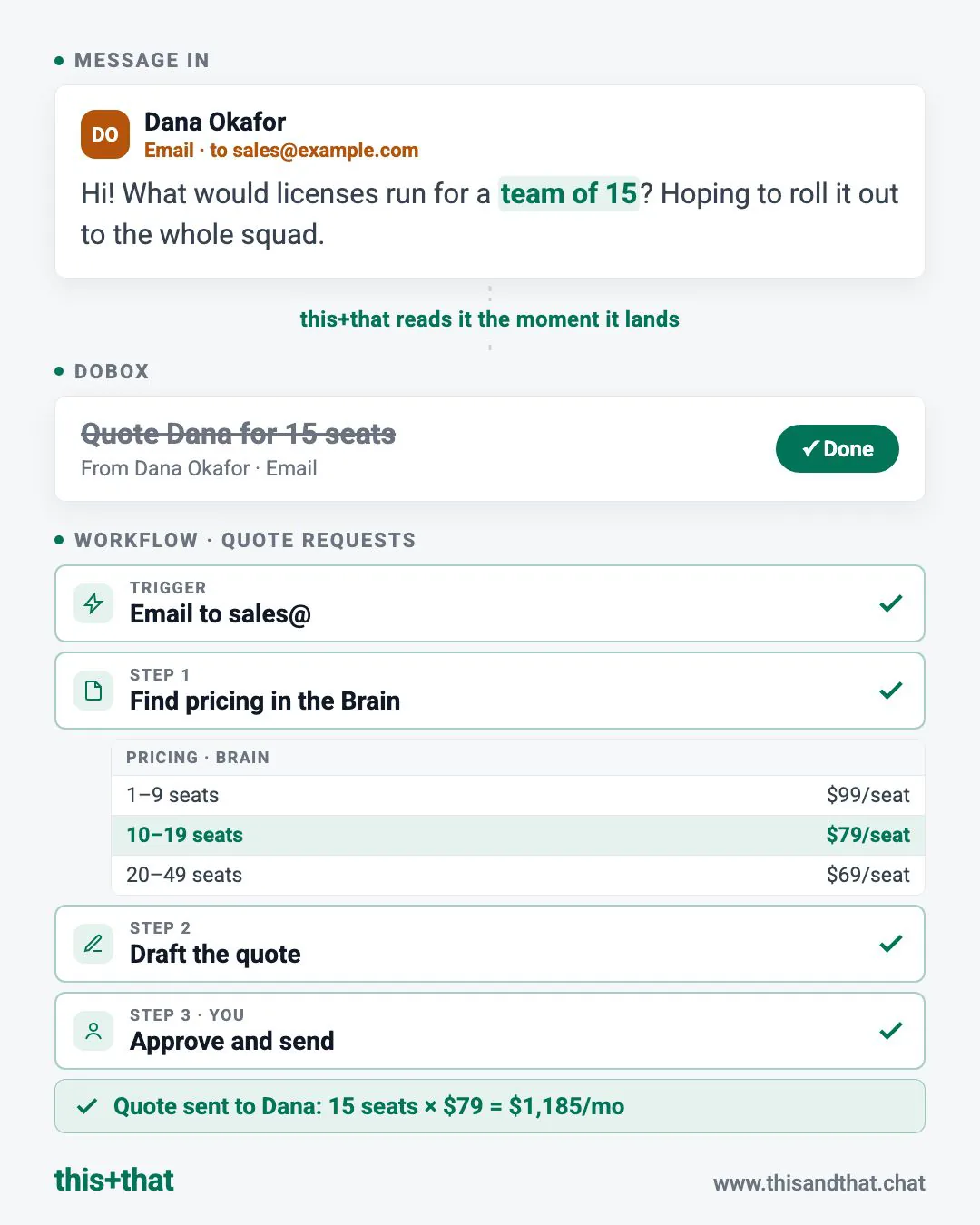
A prospect emails your sales address at 6:40pm asking what licenses would cost for a team of 15. Before she gets an answer, someone has to read the email, find the current price sheet, work out which tier 15 seats falls in, do the arithmetic, write the reply and send it. Every step is easy. Each one waits until somebody’s free, and by then it’s tomorrow morning.
Most of the work happens before the send button
Of those six steps, only the last one is risky. Reading the email, finding the price, picking the tier, doing the math and writing the draft can all be checked before anything leaves the building, so a mistake in any of them can be caught before it matters. A mistake in the sent email commits you to something you didn’t mean, or forces an awkward correction to a prospect.
So the first five steps are a task for an AI agent, and they should happen the moment the email arrives.
Should AI send things on its own?
Not until it has proven itself trustworthy. To start, someone should approve every message that goes to a customer. That’s quick once the draft is finished: approving a correct quote takes a glance, from a desk or from a phone, and the prospect who wrote at 6:40pm can have her answer that evening.
Approval also shows you how good the drafts are. Every quote that goes out exactly as drafted is evidence. Every quote someone has to fix is evidence too, and it tells you what the AI still gets wrong.
AI earns trust one kind of request at a time
An AI that writes accurate price quotes has earned trust on price quotes, and on nothing else yet. Trust builds for a particular kind of message, so hand it over the same way. After enough accurate quotes, let the AI send that kind of reply on its own and take the last delay out of the loop.
Keep approval on the messages where a mistake does more damage: a discount request, a change to a contract, a customer who’s already unhappy. A person can keep approving those for as long as you like, while the routine replies go out in minutes.
How it works in this+that
A workflow reads messages across Gmail, Outlook, Slack, Microsoft Teams, and Google Chat as they arrive and turns a quote request into a task in DoBox. It pulls the pricing from the team’s Brain, drafts the reply, and holds it at an approval step, which shows up in DoBox’s Approvals section for someone to check and send. When the team trusts that workflow’s quotes, it changes the approval step to a send step, and the reply goes out as soon as it’s written.
Start with the request your team answers most often. Approve every reply, note how often the draft goes out untouched, and use that to decide when the AI gets the send button for that request.