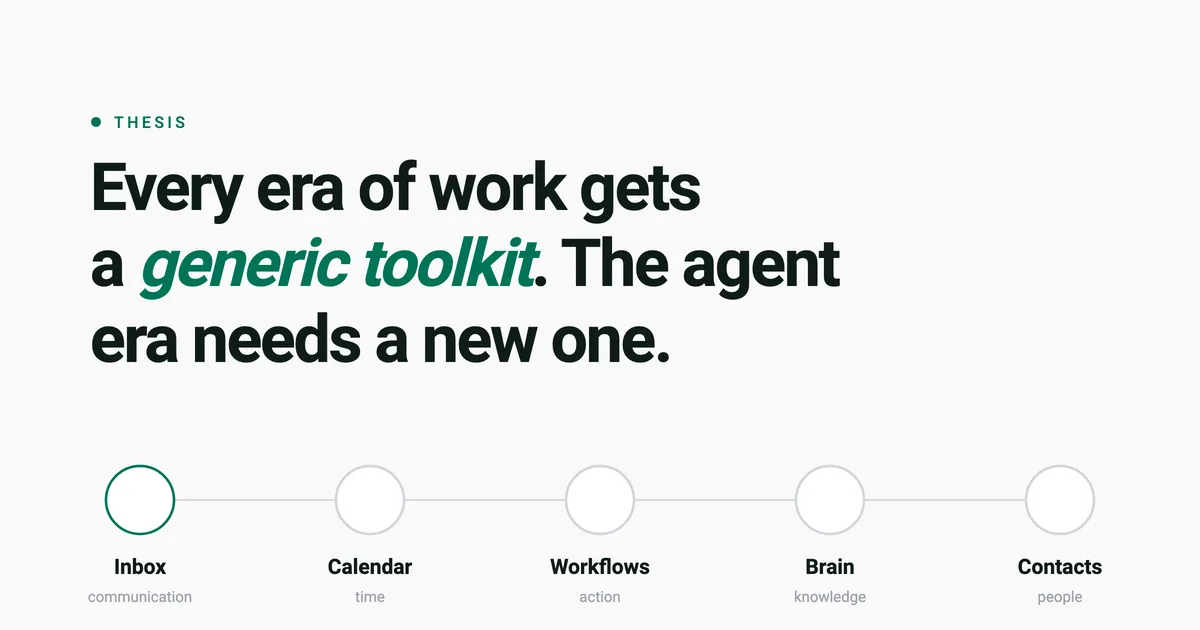
Every era of work gets a generic toolkit. The agent era needs a new one.
Every era of knowledge work gets a generic toolkit. Not the specialized software a role depends on, the CAD package, the accounting ledger, the developer’s compiler, but the layer underneath all of that, the tools everyone uses regardless of what their job is called. For most of the last thirty years that toolkit was Microsoft Office, joined by Google Workspace once it split the market from around 2005. A word processor, a spreadsheet, a way to make slides, and Outlook for mail and calendar. Whatever specialized tools your job added on top, these were the ones everyone lived in.
Office defined an era, and it defined it well.
The Office era was organized around documents
Office was built to produce documents. You opened Word because the output you needed was a document. You opened Excel because the output was a model or a sheet. PowerPoint because the output was a deck. The unit of work was the thing you made, and the tools were instruments you operated by hand to make it. A word processor is a very good place to type words when the typing is yours to do.
That assumption, that a person sits at the controls and produces documents, is baked into every part of the toolkit. The ribbon, the formatting menus, the cursor blinking in an empty document: all of it presumes a human operator. For decades that was simply what computers were for, and the design was right for its time.
The shift now underway is not that the documents got smarter. It is that a different operator showed up.
The agent era is organized around outcomes
When an agent can operate the tools, the generic layer stops being about producing documents and starts being about getting work done. The unit changes. It is no longer the documents you make; it is the outcome you want, pulled out of the stream of messages flowing past you all day: a customer support email, a colleague asking for help with a marketing plan, your boss assigning you to a new project.
Consider the most ordinary task there is: a customer emails asking for a renewal quote. In the Office era, handling that meant a person reading the mail, opening a template, typing the reply, attaching the quote, and sending it. Five tools, all operated by hand, to move one thread forward. The documents (the email, the quote) were the point, and you made each one yourself.
In the agent era you do not need a word processor to write that reply, because you are not the one writing it. The agent reads the message, understands that a renewal is being requested, drafts the response, and routes it for your approval. What you need from the toolkit is not a better place to type. It is a layer that sees the message, knows enough to act on it correctly, and can carry the outcome through.
So the generic toolkit for this era is organized around a small set of jobs that have nothing to do with making documents:
- Communication. A universal inbox across every channel, because the work arrives as messages and it arrives everywhere: email, Slack, Teams, and the rest. This is live, and it is the foundation everything else stands on.
- Coordination of time. A calendar, because a large share of outcomes resolve to “when.” This is live.
- Turning intent into action. A way to move from “this message implies work” to the work actually happening: tasks in a shared inbox of to-dos, and workflows with conditional logic, loops, and approval gates so a person signs off before anything consequential goes out. This is live, and it is where we have spent the most effort.
- Operational knowledge. A brain that grounds every agent action in what the organization actually knows: its people, its commitments, the decisions already made. The grounding is live, and workflows write back to it as they run, so it grows with the work. Getting it to keep itself fully current from your messages on its own is what we are building toward.
- The people layer. Contacts, rebuilt for this era. It is worth its own section.
You will notice what is not on that list. There is no spreadsheet here and no slide editor, and that absence is the whole argument. Those are documents. In the agent era, documents are something the agent generates on demand, or something that lives in a specialized tool we connect to, not a fixture of the generic layer. Rebuilding a spreadsheet into this toolkit would be answering the Office era’s question in the agent era. We are trying not to do that.
This is the cultural companion to two earlier pieces. One on why AI’s second wave is fit-for-purpose tools rather than one chat box, and one on the third wave of productivity software, where the agents live above the apps.
The 20th-century contact is the wrong shape
Of the jobs in that list, the people layer is the one least reshaped for the agent era. Modern CRMs like Attio have moved contacts well past the Rolodex, but they are still a database you operate. What this era needs is a people layer an agent reads before it acts, built to stay current from your messages instead of your data entry. That is the version we set out to build.
Think about what a contact has been since the Rolodex. A static card of fields. A name, a company, a title, a couple of phone numbers, an email. You maintain it by hand, and it goes stale the moment you look away. Someone changes jobs, gets a new number, takes a new title, and your record quietly becomes wrong. The 20th-century contact is a snapshot of a relationship at the instant you last bothered to update it, which is to say almost never.
That shape made sense when the address book was a thing you kept on the side. It makes no sense for a layer that an agent has to read before it acts. An agent reasoning from a stale card will get the wrong person, the wrong number, the wrong company.
The contact this era needs is not a card. It is a living record, and it has three layers.
The first is self-maintaining identity. The basic facts, name, company, role, numbers, kept current automatically from the communication already flowing through the system. A new title in an email signature, a number at the bottom of a thread: the record updates itself from what it already sees. No data entry. It works because this layer sits on the same message stream your inbox already sees, so the identity maintains itself instead of asking you to.
The second is relationship state. Not just who someone is, but where you stand with them. What you are working on together, which threads are open, the tasks tied to them, the commitments on both sides, the last decision you reached, how they prefer to be reached. The things you actually hold in your head about a person, written down in a place an agent can use.
The third is agent grounding. The record the agent consults before it acts on a message, so that an instruction like “send the renewal to our contact at the vendor” resolves to the right person without you spelling out who that is. This is the people-slice of the brain: the part of operational knowledge that is about who, not what.
The cleanest way to describe it is a lightweight CRM turned inside out. A normal CRM is a database you feed. Someone has to log the call, update the stage, attach the note, and the whole system is only as good as that discipline, which is why so many CRMs rot. The version this era needs feeds itself, because the inbox already sits on the entire message stream. The relationship is documented as a byproduct of the work, not as a second job you do after it.
We want to be careful about scope here. This is people-grounding, not a replacement for Salesforce. It is the part of the brain that knows your people well enough that the agent acts on the right ones. That is a smaller and more careful claim, and it is the one we mean.
Where this leaves Office
None of this is a verdict on Office. Office was the right toolkit for an era when humans operated the tools, and it served that era for a long time. The agent era simply asks a different question. When the operator is an agent and the unit is the outcome rather than documents, the generic layer underneath everyone’s specialized work has to be built around communication, action, knowledge, and people, not around documents and the menus for editing them.
The map is what we are confident about, and the toolkit is real. The inbox, the calendar, the tasks and workflows, the brain, and the people layer are live today. The shape of the toolkit comes from the shape of the work, and the work changed.
Key takeaways
- Every era of knowledge work has a generic toolkit underneath the specialized tools. The last one was Microsoft Office, built to produce documents by hand.
- The agent era is organized around outcomes pulled from the message stream, not documents you make. When the agent operates the tools, the generic layer is about getting work done, not editing documents.
- That toolkit is communication (a universal inbox), time (calendar), action (tasks and workflows), knowledge (the brain), and people (contacts). No spreadsheet, no slide editor, on purpose.
- The contact this era needs is a living record, not a static card: self-maintaining identity, relationship state, and grounding the agent reads before it acts. A lightweight CRM that feeds itself.
If you want to see the parts that are live, start with the brain, workflows, and how this works across a team.